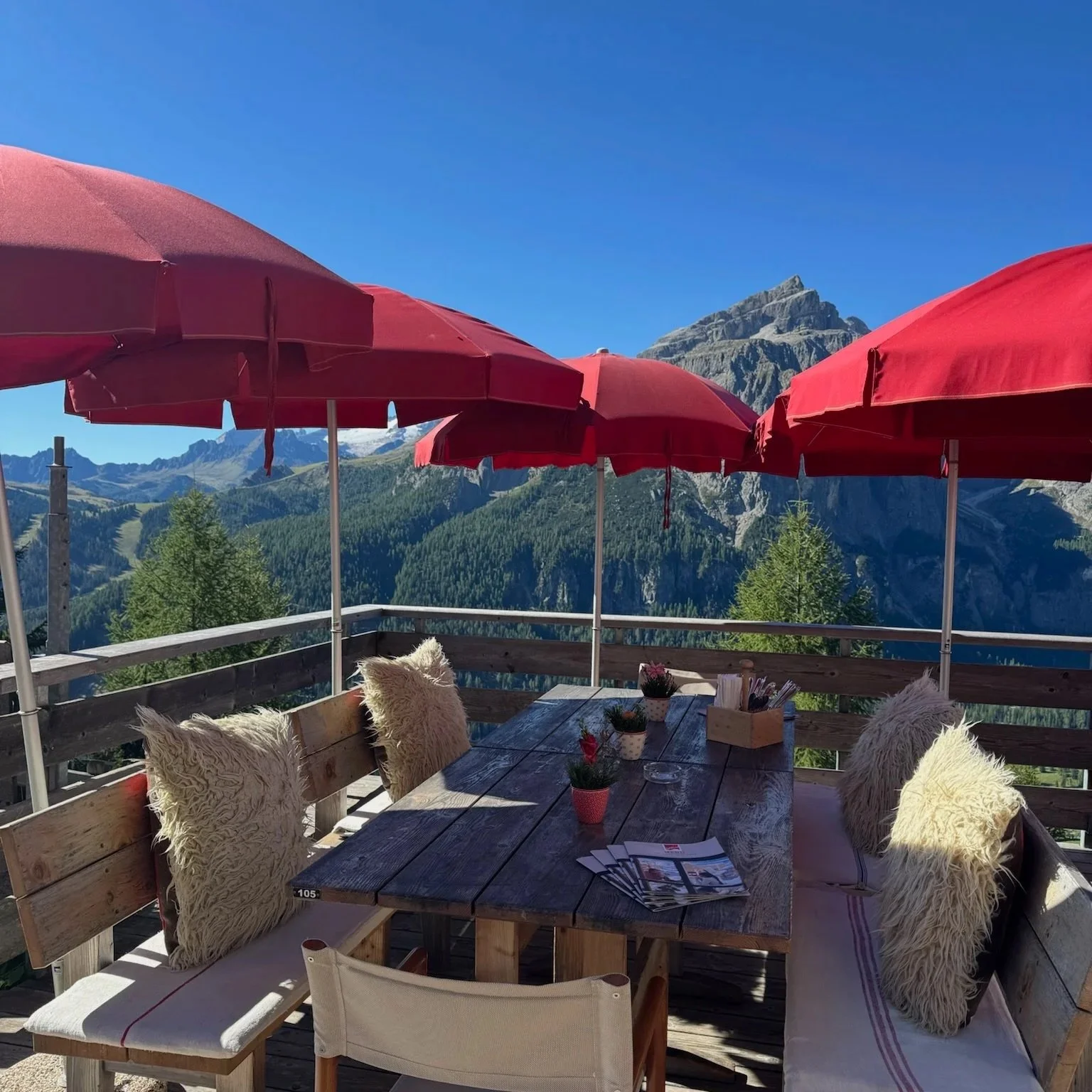
Some of my favorite days in the Dolomites have been planned around lunch.
That might sound a little strange when you're surrounded by some of the most spectacular mountains in the world, but a wonderful hike followed by a leisurely lunch at a mountain rifugio is pretty hard to beat.
And sometimes I do things backward. Rather than choosing a hike and seeing where we might stop to eat, I pick the rifugio first and find a beautiful hike that takes us there.
After 16 years of visiting the Dolomites, I've learned that the best hiking days aren't necessarily the ones where you cover the most distance or tick off the most famous places. They're often the days when you have time to enjoy where you are.
Here's how I plan those days.
Start with the rifugio, not the hike
If there's a particular rifugio you've been dreaming about visiting, start there.
But before choosing your hike, find out how you'll reach it.
Some rifugios are just a short walk from a cable car or chairlift. Others involve a proper mountain hike, and a few offer different routes depending on how much walking you want to do.
I always look at three things:
How long will it take to reach the rifugio? And not just according to the hiking signs. Allow time for photographs, breaks and enjoying the scenery.
How will you get back? If you're relying on a lift, check when the last one runs.
Is the hike worth doing? I wouldn't choose a mediocre hike just because there's a famous rifugio at the end of it. The scenery still matters enormously to me.
That last point is important. Sometimes the best combination isn't the most famous hut or the longest hike. It's the one that gives you a beautiful day from beginning to end.
Don't leave lunch too late
One mistake I'd avoid is assuming you can arrive at a rifugio whenever you like and sit down to a full meal.
Many mountain kitchens have limited lunch-serving hours, and popular terraces can get extremely busy.
Personally, I like arriving before the main lunchtime rush when possible. It gives us more time to relax rather than feeling we're competing for a table.
And if we're hiking back down afterward, I'd much rather have a leisurely lunch and plenty of time for the descent than spend the afternoon watching the clock.
Always check the rifugio's opening dates and food service hours before setting out. If you're visiting in June or late September, this is particularly important.
Some famous rifugios aren't my favorites
This is where personal preferences make a difference.
Take Rifugio Jimmi, for example.
The location is incredible, and the mountain views are spectacular. I completely understand why people love it.
But personally, I found it quite busy, expensive and perhaps a little overhyped.
I felt similarly about Geisler Alm in Val di Funes. It's in a beautiful setting, and I understand why so many people love it. But I actually preferred Malga Dusler along our hike.
And when we hiked toward Rifugio Re Alberto in the Catinaccio area, I preferred stopping at the smaller, quieter Rifugio Paul Preuss rather than the busier Rifugio Vajolet.
I've always been drawn to the quieter, less obvious places. I'm rarely the person who automatically prefers the most famous spot, even when I can appreciate why it's popular.
That's one of the things I love about the Dolomites. Sometimes the place you enjoy most isn't the one everyone is talking about.
If you're looking for more mountain hut inspiration, I've shared some of my recommendations in my Dolomites Food Guide.
One of my favorite rifugio afternoons was spent doing almost nothing
One afternoon at Sofie Hut on Seceda, I settled in with a book and ended up staying for ages.
The food and drinks were fantastic, the setting was beautiful, and there was absolutely no reason to rush off somewhere else.
I still remember that afternoon so fondly.
It's a good example of something I think people sometimes miss when planning their Dolomites trips.
You don't need to fill every hour.
At Ütia Bioch in Alta Badia, I love stopping for a coffee simply because the chairs are so comfortable and it's such a lovely place to sit and enjoy the mountains.
Those moments might not look particularly impressive on an itinerary, but they're often some of my favorites.
Sometimes getting to the rifugio becomes the adventure
I'll never forget our visit to Rifugio Toni Demetz, high up on the Sassolungo.
We'd planned to use the little standing cable car from Passo Sella, the one often nicknamed the coffin cable car.
Unfortunately, it was closed because of high winds.
So instead, we hiked up the steep zigzag trail.
It was cold, it was hard work, and by the time we reached the top, we were more than ready for something to eat.
I had the most wonderful bowl of soup and fries. After that climb, they tasted absolutely fantastic.
I also loved the traditional, old-school atmosphere of the hut.
It's still one of my most memorable rifugio visits, partly because getting there didn't go according to plan.
But I wouldn't suggest everyone tackle that hike simply because the cable car is closed. It's a demanding ascent, and you need to be comfortable with the terrain and conditions.
Sometimes changing the plan is the sensible decision.
Remember that you still have to get back
It's very easy to focus on the hike to the rifugio and forget about the return journey.
But the descent can be just as important, particularly if someone in your group struggles with steep or uneven terrain.
I always check the entire route, not just the climb.
If a cable car or chairlift is involved, make sure you know the operating hours and allow a comfortable margin for getting back.
Mountain weather can change quickly, particularly during summer afternoons, so I wouldn't plan a long, exposed return route simply because I wanted another hour sitting on a terrace.
And if the weather looks questionable, I'd rather change the day than force the original plan.
If a cable car or chairlift is involved, make sure you know the operating hours and allow a comfortable margin for getting back. My Dolomites Cable Cars Guide is a useful starting point for checking which lifts serve the areas you're visiting.
Think about how lunch fits into the rest of your day
This is something people don't always consider.
If you're staying at a hotel with half board, you may already have a substantial dinner included every evening.
Add a big rifugio lunch, and that can be a lot of food!
Sometimes we'll make lunch the main event. Other days, we'll have something lighter and look forward to dinner at the hotel.
There's no right answer, but it's worth thinking about before planning a big mountain lunch every single day.
And remember to carry a little cash. Although many rifugios accept cards, I wouldn't rely on that everywhere.
The best rifugio day is about more than lunch
For me, a great rifugio day combines spectacular scenery, a hike I genuinely enjoy, good food and enough time to appreciate it all.
I love Rifugio Bolzano because the hike and the views are extraordinary. It's one of those places where I'd really love to spend the night someday.
I also love the views from Rifugio Col Alt, the more traditional feel of Rifugio Franz Kostner, and spending time at Rifugio Pralongià.
They're different experiences, and that's part of what makes exploring the Dolomites so wonderful.
But I wouldn't choose a rifugio simply because it's on someone's list of the ten best mountain huts.
I'd choose the one that fits the hiking day you actually want to have.
Planning your own rifugio days?
If you're planning your first Dolomites trip, remember that the best hiking day isn't necessarily the one with the most stops.
Sometimes I'd much rather spend an extra hour enjoying a beautiful rifugio than rush off to squeeze in another attraction.
And if you'd like help choosing hikes that combine spectacular scenery, enjoyable rifugio stops and realistic timing, that's exactly the kind of detail I consider when creating a Custom Itinerary.
