Dolomites rifugi: a first-timer’s guide to mountain huts
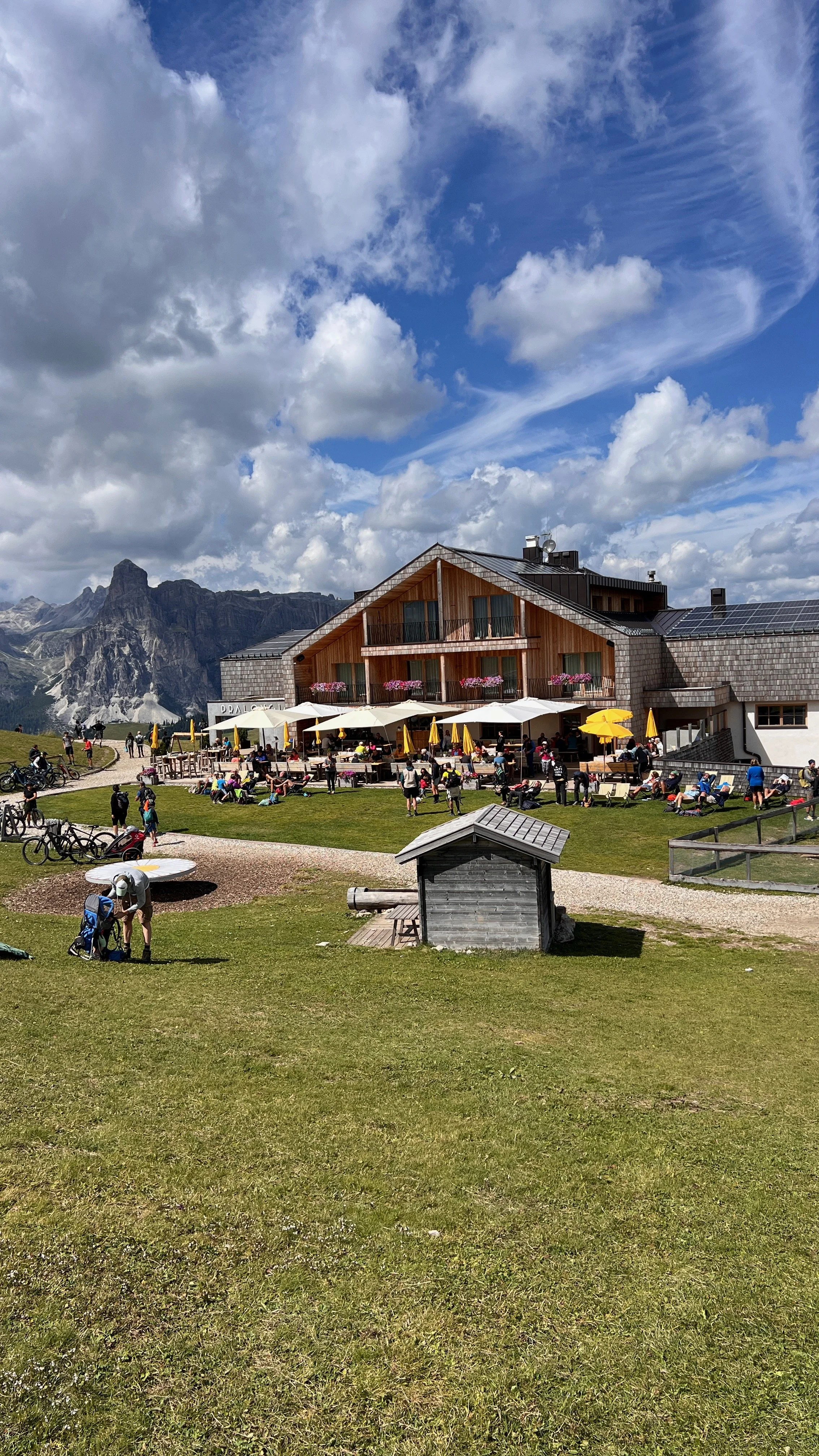
Rifugi are one of my favorite parts of a Dolomites trip. They are mountain huts where you can stop for lunch, drinks or sometimes stay overnight, and they are much more central to a day in the mountains here than many first-time visitors expect.
After 16 years of traveling in the Dolomites, I rarely plan a hiking day without thinking about where we might stop for lunch. Here is what you need to know before visiting your first rifugio.
What is a rifugio?
Rifugio is singular; rifugi is plural. You will also see the German word Hütte used in South Tyrol.
A rifugio is a mountain refuge or hut, but the word hut can give first-time visitors completely the wrong impression.
Some are simple and rustic. Others have large sunny terraces, excellent restaurants and surprisingly comfortable accommodation.
Most serve food and drinks during the day, and many also have rooms or dormitories for hikers staying overnight.
They are part restaurant, part mountain refuge and, in many cases, part hotel.
More importantly, they are part of the Dolomites experience.
You do not have to be doing a difficult hike to enjoy one. Many fantastic rifugi can be reached using cable cars followed by relatively short walks.
If that sounds more like your kind of day, my Easy Dolomites guide covers ten beautiful places you can reach without doing a long hike.
What to expect
Do not expect a restaurant in town transported into the mountains.
A rifugio has its own rhythm.
On a sunny summer day, hikers arrive throughout the morning, walking boots pile up around tables, people stop for coffee or lunch, and the terrace can become very busy.
That is part of the atmosphere.
Some rifugi have table service while others require you to order inside. Menus vary considerably depending on where you are and how remote the rifugio is.
And the setting matters as much as the food.
Sitting outside with the mountains around you is often one of those moments people remember long after they have forgotten exactly which trail they walked that day.
Do you need a reservation for a rifugio?
For lunch, usually not. In all my years visiting the Dolomites, I have rarely needed to reserve a table at a rifugio. Most people simply arrive, find a table and order.
Overnight stays are completely different. If you plan to sleep at a rifugio, book ahead, especially in July and August or on popular hut-to-hut routes. Beds at well-known huts can fill long before the trip.
If you have your heart set on lunch at one particular rifugio during a busy period, it never hurts to check its website or call ahead.
For more on what really needs booking before your trip, read What to book in advance for the Dolomites.
What should you order?
The food is often one of the biggest surprises for first-time visitors.
This is not usually basic hiking food.
Depending on the area, you might find canederli, goulash, polenta, pasta, barley soup, Kaiserschmarrn, apple strudel and other South Tyrolean and Ladin dishes.
Coffee, beer, wine and cold drinks are standard too.
Menus vary from one rifugio to another, which is part of the fun.
Vegetarian choices are usually fairly easy to find. If you have more specific dietary requirements, I would check ahead rather than assume a remote mountain kitchen will be able to accommodate everything.
Prices vary considerably from one rifugio to another. Some are simple mountain huts with straightforward menus, while others are known for food and feel much closer to a proper restaurant. I usually budget for a full lunch rather than treating a rifugio as somewhere to grab a quick snack.
Personally, I would rather build time into the day for a proper rifugio lunch than rush through with a packed sandwich just to fit another sight into the itinerary.
Lunch stop or overnight stay?
These are two very different experiences.
For most visitors, a rifugio is simply part of a day in the mountains.
Walk or take a lift up, stop for lunch, spend some time enjoying the view and then continue your route.
That is enough to experience rifugio culture and requires very little extra planning.
Staying overnight changes the experience completely.
Once the last cable cars have gone and the day visitors disappear, the mountains become much quieter. You have dinner with the other overnight guests, sleep in a simple room or dormitory and wake up before most visitors arrive.
Bathrooms may be shared. Rooms are generally simple. Some showers may have an extra charge.
A rifugio is not a luxury mountain hotel.
But that isn't really the point.
Sunset and early morning in the mountains can be extraordinary, and an overnight stay allows you to experience a side of the Dolomites that day visitors never see.
The unwritten rules
You do not need to know a complicated set of rifugio rules before you visit.
A few simple things are enough.
If you sit at a table, order something.
Be patient when it is busy. Staff may be serving a huge number of people in a mountain location where everything is harder to deliver and manage than it is in town.
Do not expect every rifugio to operate in exactly the same way.
And most importantly: do not rush it.
One of the mistakes I see people make when planning the Dolomites is trying to fit too much into every day.
A rifugio should not just be a fifteen-minute refuelling stop between attractions.
Order lunch. Have another coffee. Sit outside. Look at the mountains.
That is part of the day.
Cash or card?
Card payments are increasingly common, but I still carry some cash in the mountains. Signal and payment systems are not something I want to rely on at a remote rifugio, especially if I am several hours into a hike.
What are overnight stays really like?
Accommodation varies enormously.
Some rifugi have traditional dormitories with multiple beds. Others offer private rooms as well.
You should expect things to be simpler than at your valley hotel: fewer facilities, shared spaces and less privacy.
But you gain something completely different in return.
There is something special about being high in the mountains after everyone else has left for the day.
You also start the following morning already in the mountains, which can completely change how a hiking day works.
If you are considering a hut-to-hut trip, I would look at the individual rifugi carefully rather than assuming they are all alike. Comfort levels, access and facilities can be very different.
A few rifugi worth knowing
There are hundreds of rifugi across the Dolomites, and I would never choose one simply because it appears on a list of the “best.”
The right rifugio depends on where you are staying and what kind of day you want.
But a few give you an idea of how different the experience can be.
Rifugio Lagazuoi, above Passo Falzarego near Cortina, has one of the most dramatic locations and can be reached by cable car.
Baita Sofie, just below the Seceda summit, is one of my favorite stops in the area, easy to reach, beautiful setting, and known for Tyrolean food and an excellent wine selection. It works perfectly into a Seceda day rather than feeling like a separate destination.
Ütia de Bioch, on the Pralongià plateau in Alta Badia, is another favorite for a relaxed mountain day. It is easy to combine with the lifts from Corvara or San Cassiano and works particularly well if you want gentle walking followed by a long lunch.
Rifugio Fanes is a very different experience, sitting deep within the Fanes-Sennes-Braies Nature Park and particularly well suited to an overnight mountain stay.
Geisler Alm, in Val di Funes, is one I like building into an Adolf Munkel Trail day. The setting below the Odle peaks is the reason to come, and it works naturally as the lunch stop rather than a separate destination.
How to work a rifugio into your Dolomites day
This is the part I think matters most.
Do not start by making a list of famous rifugi and then try to drive around visiting them.
Start with the day.
Where are you staying? How much hiking do you actually want to do? Which lift makes sense? What scenery do you want to see?
Then choose the rifugio that naturally fits that route.
That is how I plan my own Dolomites days and how I plan trips for clients.
My advice is not to treat rifugi as incidental lunch stops. Build them into the day. A good mountain walk followed by a long rifugio lunch is one of the simplest ways to make a Dolomites day work well.
Need help putting this together?
If you want to plan your own Dolomites trip but need help choosing the right bases, organizing your days and avoiding the planning mistakes that waste time, my Dolomites Itinerary Toolkit gives you the framework I use to put a trip together.
If you would rather have personalized help, I can help you choose where to stay and build a trip around your dates, hiking level, priorities and travel style.
