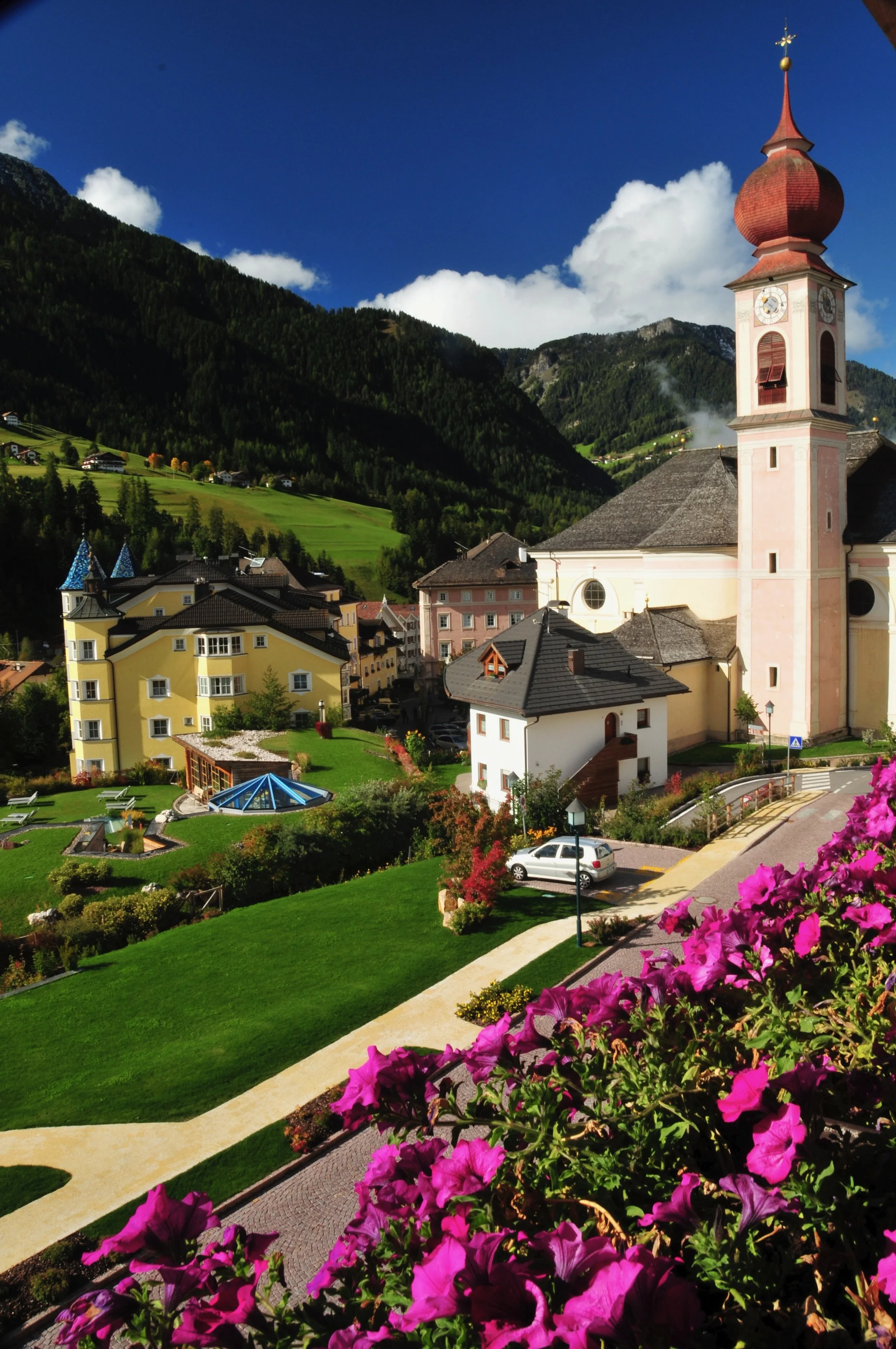
Visiting the Dolomites without a car is possible, but it requires more thought about where you base yourself than a standard trip. The region is spread out and some of the most famous locations are genuinely difficult to reach without driving. Get the base right and a car-free trip works well. Get it wrong and you spend your holiday waiting for buses.
Here is what actually works.
What makes a base work without a car
Three things matter. Direct cable car access from the town centre so you can reach mountain viewpoints without any transport. Good local bus connections to nearby villages and areas. And enough variety within walking or easy reach that you are not dependent on getting somewhere else every day. If those three things are in place, a car-free trip can be genuinely straightforward.
Ortisei: the best car-free base in the Dolomites
Ortisei is the clearest answer for anyone visiting without a car and it is not particularly close. From the town centre you can take the cable car directly to Seceda, one of the most iconic viewpoints in the Dolomites, and a separate gondola up to Alpe di Siusi. Both are walkable from the main street. The Val Gardena bus service connects Ortisei to Selva and Santa Cristina regularly throughout the day, which gives you access to the rest of the valley without needing to drive. The town itself is compact, walkable, and has enough restaurants, shops, and atmosphere to make evenings enjoyable without going anywhere.
For a first-time visitor without a car, Ortisei removes almost all of the logistical friction that would affect other bases. One or two cable car days, easy bus trips into the valley, and a good base to come back to in the evenings.
If you’re also looking for an easy 3–5 day trip plan, see my Dolomites itinerary for non-hikers.
For more on the area: Ortisei Weekend Guide
Selva di Val Gardena: a solid alternative
Selva sits further up the same valley as Ortisei and has its own lift access, including the Col Raiser cable car and connections into the Sella Ronda ski circuit area. The bus service through the valley links it easily to Ortisei and Santa Cristina. It is slightly less central than Ortisei and the town centre is a little more spread out, but for a car-free trip it works well. A good option if you want to be a bit further from the busier end of the valley.
Corvara: easier without a car than you might expect
Corvara can also work well without a car, especially if you plan to spend most of your time in Alta Badia rather than trying to reach every famous sight in the Dolomites.
The village has lift access directly from town, and Alta Badia now has a useful network of public buses and local summer services connecting villages and lift stations. Guests at participating accommodations receive the South Tyrol Guest Pass, which covers much of the regional public transport network.
Where Corvara becomes less convenient is for sightseeing outside Alta Badia. If your priority is Seceda, Lago di Braies, Tre Cime and Cortina all in one trip, a car gives you far more flexibility.
But for a slower trip focused on Alta Badia itself, I would no longer rule Corvara out simply because you are not driving.
For more on Corvara: Corvara Travel Guide
San Candido: the best eastern option without a car
If your priorities are in the eastern Dolomites, San Candido is worth considering. It sits on the regional train line and has bus connections toward Sesto, Dobbiaco and the surrounding valleys.
It does not give you the same easy access to the central Dolomites as Ortisei, so I would choose it only if your trip is focused on the 3 Peaks area rather than Seceda, Alpe di Siusi and Alta Badia.
For the right itinerary, though, it is a genuinely practical car-free base.
What becomes difficult without a car
A car-free Dolomites trip works best when you choose one well-connected area and stay mostly within it.
It becomes much harder if you want to jump between Val Gardena, Alta Badia, Cortina, Lago di Braies and Tre Cime in a few days. Public transport exists, but cross-valley journeys can involve changes and eat into the day.
The same applies if you want very early starts, remote trailheads or complete freedom to stop along the mountain passes.
So I would not ask, “Can I visit the Dolomites without a car?” You can. The better question is, “Am I willing to plan the trip around one area rather than trying to see everything?”
The honest reality of car-free travel here
Going without a car does not mean a worse trip, but it does mean a more focused one. You will see less of the wider region and you will need to accept that some locations are simply not accessible. The trade-off is a simpler, lower-stress experience based around one area done properly rather than trying to cover everything.
Ortisei based for the full trip, Seceda and Alpe di Siusi as the main days, bus trips within the valley for variety, and good evenings in a walkable town. The realistic 5-day itinerary shows how those days can be structured That is a complete and genuinely excellent Dolomites trip without a car.
For help deciding on the right base: Download the free Dolomites Base Guide
For more on where to stay as a first-time visitor: Where to Stay in the Dolomites for First-Time Visitors
Want a clear plan for a car-free trip?
If you want someone to look at your dates and put together a realistic car-free itinerary that actually works, the planning service is exactly what it is there for.
