The most scenic viewpoints in the Dolomites for photography
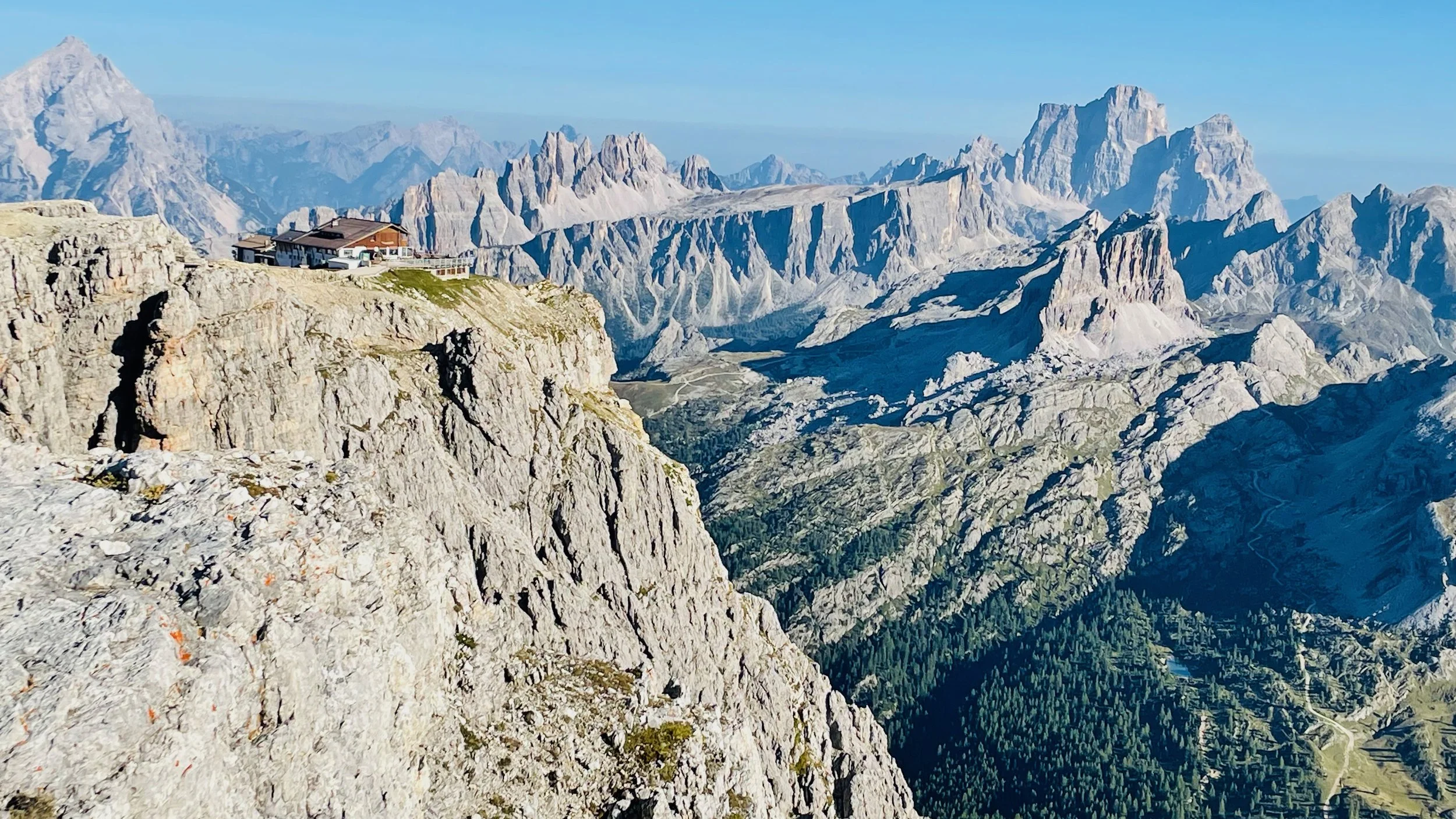
You do not need to be a professional photographer to come home from the Dolomites with extraordinary images. The landscapes do most of the work - sharp pale peaks against blue skies, soft alpine meadows, moody cloud that wraps around the rock faces, and a quality of golden light in the early morning and late afternoon that feels almost designed for photography.
What you do need is to be in the right place at the right time. This guide covers the viewpoints that consistently deliver strong images, the best light for each one, and exactly where to position yourself when you get there.
Seceda, Val Gardena
Seceda is the most photographed viewpoint in the Dolomites and the reputation is deserved. The long jagged ridgeline of the Odle peaks stretching across the horizon is one of the most immediately striking landscapes in the Alps - the kind of scene where even a phone camera pointed in roughly the right direction produces something remarkable.
The best light at Seceda is in the morning, when the sun is still low and the shadows on the rock faces are long and defined. Take the first or second lift of the day - arriving before most other visitors not only gives you better light but quieter foregrounds. Walk directly to the ridge viewpoint from the upper station, a 10 to 15 minute flat walk, and find a position looking north along the line of peaks.
Late afternoon also works well, particularly in September and October when the warm light falls directly on the pale limestone faces. The classic composition has the ridgeline running diagonally across the frame with the valley falling away below - walk a little further along the path from the main viewpoint to find slightly different angles that most visitors miss.
For everything you need to know about visiting Seceda, read my Seceda guide.
Lagazuoi, above Passo Falzarego
The cable car from Passo Falzarego rises to 2752 metres and the 360 degree panorama from the summit is one of the best in the Dolomites. The layered peaks of the Ampezzo Dolomites stretch in every direction and the light changes constantly as clouds move through the wide sky above.
The best time to visit Lagazuoi for photography is late afternoon, when the alpenglow - the warm pink and orange light that falls on the pale limestone faces at sunset - is at its most dramatic. The Tofane group across the valley and the Marmolada glacier to the south both catch this light beautifully. Position yourself near the summit cross for a clean foreground or drop slightly below the rifugio for wider shots with the peaks framed against the sky.
Lagazuoi also combines well with a drive over Passo Giau - two of the best photography locations in the Dolomites within 30 minutes of each other. For more on combining these in a day, read my Scenic Drives guide.
Alpe di Siusi, Val Gardena
Alpe di Siusi is the largest high-altitude alpine meadow in Europe and one of the most photogenic landscapes in the Dolomites. Wide, flower-covered plateau in summer, the Sassolungo and Langkofel groups rising dramatically at one end, small wooden huts scattered across the meadow - it is soft and beautiful in a way that the more dramatic peaks are not.
Sunrise is the best time for photography on Alpe di Siusi. Mist is common in the early morning and when it sits in the valley below with the peaks above, the effect is extraordinary. The plateau is reachable by cable car from Ortisei or Siusi - arriving early enough for sunrise requires taking the gondola from Ortisei before it officially opens, which is possible by walking up to the Compatsch area, or staying overnight on the plateau.
Any time of day works for photography here - the open, even terrain means the light is rarely harsh. Walk between the rifugi and turn around often; the angles change constantly across the wide meadow.
Santa Maddalena, Val di Funes
The small church of Santa Maddalena above the Val di Funes valley is one of the most photographed villages in the Dolomites - and for good reason. The combination of the little church, green summer meadows, and the jagged Odle peaks rising directly behind it is a classic composition that reproduces beautifully at any skill level.
The best time is late afternoon or golden hour when the warm light falls on the south-facing slopes and the church is lit while the valley below is in shadow. The official panoramic viewpoint above the village - a fenced platform a short walk up from the road - gives the clean, high-angle shot you see in most photographs.
Val di Funes is about 30 minutes from Ortisei and makes an excellent half-day excursion from a Val Gardena base.
Passo Giau, near Cortina
Passo Giau is one of the most dramatic mountain passes in the Dolomites and one of the best for landscape photography. The road climbs to 2236 metres through open terrain with wide views in every direction - the Nuvolau and Ra Gusela peaks rising above the pass, the Dolomites stretching to the horizon in multiple directions.
Sunset is the standout time at Giau - the entire pass glows with alpenglow on a clear evening and the wide open terrain means you can move freely to find the best composition. Start near Rifugio Passo Giau and walk five to ten minutes up the hill for a higher angle that clears the road.
Morning also works well at Giau, with mist occasionally sitting in the valleys below the pass and the light falling cleanly on the surrounding peaks.
Pralongià Plateau, Alta Badia
The Pralongià plateau above Corvara is one of the most underrated photography locations in the Dolomites. Wide rolling meadows at around 2000 metres, rifugi dotted across the open terrain, and 360 degree views across the surrounding mountain groups. It is easy to reach by chairlift from Corvara and the gentle terrain means you can wander freely without any hiking commitment.
The light here is consistently soft because the terrain is open and wide with no single dramatic feature casting strong shadows. The Sassongher peak above Corvara makes a strong backdrop in one direction; the Sella Group in another. Walk between Rifugio Bioch and the other huts on the plateau and turn around often - the compositions change constantly across this wide, open landscape.
Passo Gardena, between Corvara and Val Gardena
Passo Gardena is often overlooked as a photography location because people drive through it on the way somewhere else. That is a mistake. The road near the top of the pass curves around some of the best mountain backdrops in the central Dolomites - the Sella Group rising on one side, the Puez-Odle peaks on the other.
Morning light is best at Gardena. Stop at the pull-offs near the top of the pass and around the rifugio and gondola station - there are several spots within a short walk of each other that give very different compositions. It is also one of the few viewpoints in the Dolomites where you can get genuinely strong images without leaving the road.
Tre Cime di Lavaredo, 3 Peaks area
The Tre Cime are the most famous landmark in the Dolomites - three extraordinary rock towers rising from a lunar plateau in the eastern Dolomites. The classic viewpoint is a 45 minute walk from Rifugio Auronzo, easy by Dolomites standards, and the scene when you arrive is genuinely unlike anything else in the region.
Late afternoon and sunset are the best times - the rock faces of the towers catch warm light beautifully and the sky above the peaks in the hour before sunset is often spectacular. Arrive early in the day to secure parking at Rifugio Auronzo and time your walk out to the viewpoint for the afternoon light.
Simple tips for better Dolomites photography
Go early or stay late. The best light in the Dolomites is in the first hour after sunrise and the last hour before sunset. Midday light is flat and harsh - use it for travel between locations rather than shooting.
Clouds improve almost every photograph. The Dolomites with dramatic cloud are more interesting than the Dolomites in flat blue sky. If you wake up to a partly cloudy day, that is good news for photography.
Add foreground interest. Alpine flowers, wooden fences, rifugio signs - anything that gives the viewer a place to enter the frame before the eye travels to the peaks in the distance.
Shoot both orientations. A horizontal and a vertical at every location gives you far more flexibility when you get home.
Phone cameras work well in the Dolomites. The contrast and colour of the landscapes suit phone processing well. Tap to set focus and reduce exposure slightly if the sky is very bright.
Free guide: Easy Dolomites - 10 incredible places without long hikes
Most of the best photography locations in the Dolomites are reachable by cable car or short walk. My free guide covers 10 of them with practical notes on access and what to expect at each one.
Download the free Easy Dolomites guide
Want someone to plan the photography trip?
Connecting the best viewpoints into a realistic day-by-day itinerary - the right bases, the right timing, the right order - is exactly what my trip planning service is for.
